Nazad na blog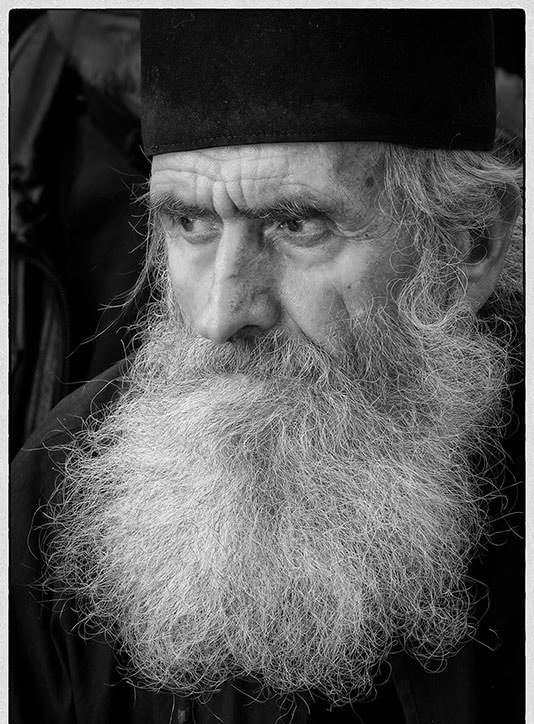
April 29, 2026
Monk Zosimas of Hilandar
Monk Zosimas was born in Romanija, in Bijele Vode, Sokolac municipality, as Vaso Krsmanović, which was his secular name. He worked in the timber industry, processing wood. In the church of Saint Prophet Elias, as a layman, he regularly prayed and stood during services like the shadow of a candle. I first met him as a little boy of 5-6 years old, and I remember him ever since. After the Divine Liturgy, I would run home with the words: "Vaso is here for coffee!" Regular at Liturgies and active in the spiritual life of the local church, Vaso soon found himself in Ostrog Monastery, where he became a novice for a period of 5-6 years. Finally, he went to the imperial lavra of Hilandar, where he was tonsured a monk.
Monk Zosimas, as a hermit in a crowd, is often marginalized but noticeable. This is both a blessing and an ascetic feat for a monk. The abbot would recognize his humility and swiftness, often including him in his sacred retinue in worldly matters. Zosimas is on obedience in the Serbian cell of Flask in Karyes, a Hilandar cell with a chapel dedicated to the Nativity of the Most Holy Theotokos. An old, dilapidated, and preserved sanctuary, devoid of worldly necessities, it testifies to the rich spiritual life of Mount Athos, on every inch of the Holy Mountain. Within it are choir stalls in the chapel with an iconostasis, cells, and interesting 16th-century iconography. Already at the very beginning, entrusted with obedience by the Hilandar abbot Methodius, Monk Zosimas showed his zeal. One day, the Greek brotherhood entered and locked the sanctuary. Monk Zosimas entered Flask through a small window, after which seven newly arrived monks left the cells due to this intervention.
Immediately at the very beginning, entrusted with obedience by the Hilandar abbot Methodius, Zosimas showed both his zeal and that he faithfully preserves what he brought from his homeland. When a big fire broke out in Hilandar in 2004, Monk Zosimas ran from the fire in the konak and his cell to save his scythe, with which he mowed grass, and an axe, which he had brought from his native Romanija mountain. Approachable to the people, sometimes rejected and marginalized, he is precisely the embodiment of Christ's beatitude: "Blessed are the poor in spirit." When he visited his homeland, there was no home, church, monastery, temple, or sanctuary he would visit without leaving at least a small icon and his quiet prayer. Every gift, present, or note he received he would multiply in the spirit of Macarius, giving to the monastery and the needy. This is evident in everything, especially in his humble monastic rasa, footwear, panakamilavka, and his entire life and way of being. Well-meaning and discerning observers would say that his appearance resembles the image of the icon of St. Sava by the painter Paja Jovanović, which he painted based on motifs from the Studenica and Mileševa monasteries.