Nazad na blog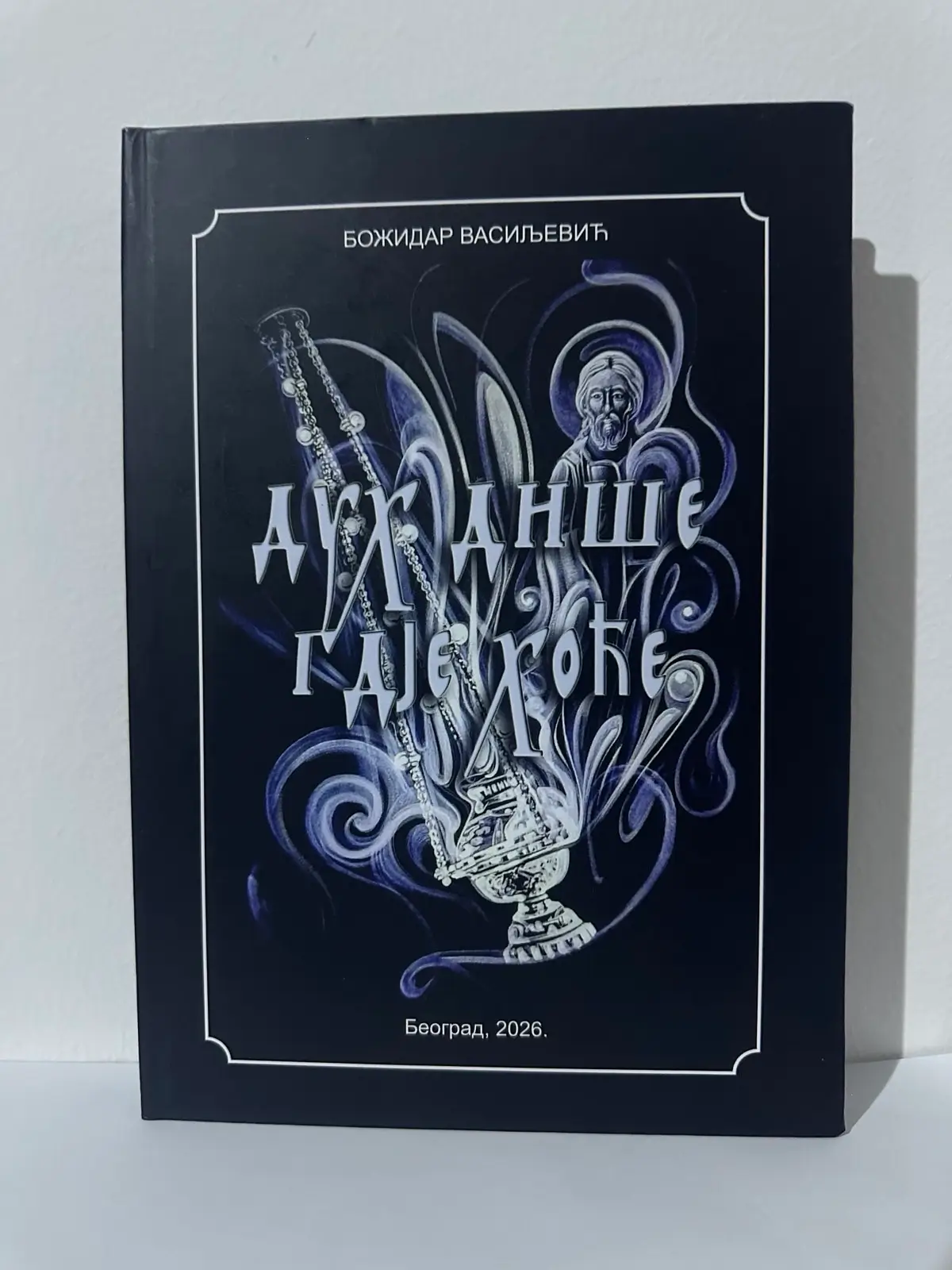
April 30, 2026
Deacon Božidar Vasiljević's New Book: "The Spirit Breathes Where It Wills"
Božidar Vasiljević's book: "The Spirit Breathes Where It Wills" is sublime and realistic. Upon first reading, it seems spontaneous and accidental, like a powerful and capricious swollen river, whose waters flow through many currents, flooding many shores and carving many continents. Here are the author's notes on events in the wider milieu of the Orthodox Church and beyond, observations on Karl Barth and Ratzinger, leading Catholic theologians. Observations on the "spirit of the times" and the enduring dogmas of the One, Holy, Catholic, and Apostolic Church. Perhaps there will be readers who will pause at the external and untamed layer of the book. However, a careful reading forces us to realize that this is just a clever facade. With years of scientific work, our sense of precision grows, and of course, the author's sense of theological line and architecture grew, that theological architecture that contributes to our sense of the transparency of vaults, of the great pneumatological and theurgical labyrinth of Christ's Church. In the book, the dogmatic, orthodox straight line is refined with the warm colors of "sweet Orthodoxy" (Miloš Crnjanski). In the work of Mr. Božidar Vasiljević, our esteemed deacon and exemplary doctoral student of Theological Studies, we can see a wide spectrum of religious nuances, but what distinguishes this work is that qualitative nuance of universal and Orthodox eternity. The author, like a Flemish and Renaissance painter, presents us with various spectra of events in the Church, recording its testimony in time and space. For, "The Lord has adorned His word with many colors to instruct everyone, considering what is necessary for them. In His word, He has hidden many treasures, so that each of us, wherever we toil, may also be enriched." The Lord's word, along with many teachings, also gives us many reflections, as Saint Ephrem the Syrian says in his famous work: "The Lord speaks." Vasiljević carefully and meticulously describes all the events of the recent history of the Christian Church through the prism of Orthodox Christ, through the prism of eternity (Sub speciae aeternitatis). Holy Tradition encompasses the entire Christian life and, through the Eucharist, extends to all Christians and for all time. The liturgical rhythm also follows the living images of New Testament history. As do the pericopes about the only Saint who, by grace, bestowed holiness, about the Lord Jesus Christ. The text covers various genres, absorbed from the rich Judeo-Christian heritage. A living heortology accompanies this work, through segments of Christian history, where the truths of faith, the entirety of salvation and healing were communally decided, but not individual utilitarian salvation, as it is most often perceived, but soteriology in communion with all the saints. This study moves with ease through the history of patristic theology, through the Cappadocian synthesis, as well as through all the trinitarian deviations that are reflected in our modern Church history. Through the texts, you will feel the Christological search for a God-man balance, where the Church, by the Holy Spirit, skillfully avoided anthropological pessimism and the anthropological maximalism and Prometheanism of modern man. What hovers over Vasiljević's rich mosaic is the deification of man and his union with Christ, that is, the re-establishment of Christ's image in man. The author's spiritual-educational thought of Christianity has avoided the individualistic conception, in which goals—progress, justice, equality—are assessed only from the standpoint of individual rights and where society is understood only as a collection of atomized units, as alienation, existential vacuum, and depersonalization. This is Božidar Vasiljević's personal approach to participants in education, as free persons in the Body of Christ, to seriously and responsibly confront the contradictions and challenges of their time, in order to avoid the cataclysmic consequences that a cruel technological civilization can produce. In the author's opinion, the personal perspective increasingly attracts, explicitly or implicitly, theorists, participants in new social movements, and all those who care about the future, not only of their own society but also of the planet. Man's world is at a crossroads today more than ever before. The future blossoms. The future of the world depends on whether we turn to Christian education as a sober spiritual struggle of a whole person who participates in God and engage in avoiding the traps we have created in modern civilization, or whether we will continue to irrationally rush into the impending cataclysm. The personal principle emanating from Vasiljević's book orientates us towards new possibilities of dynamic development directed towards the Eschaton, towards the future, that is, towards metahistory and the New Man in Christ Jesus. The author's work differs from conceptions that turn to a rigid past as a model for solving modern problems of existence. Every spiritual struggle in the Church of God must be based on living Tradition, "for Jesus Christ is the same yesterday and today and forever." (Hebrews 13:8). Also, Christian education, according to the author, attaches importance to moral demands, contrary to the pragmatic utilitarianism of dominant political projects that deny or ignore moral principles and values. Indeed, this work is a call to modern man to question the meaning of his life in the Church of God. For as the author himself said: "The Spirit breathes where it wills."