Nazad na blog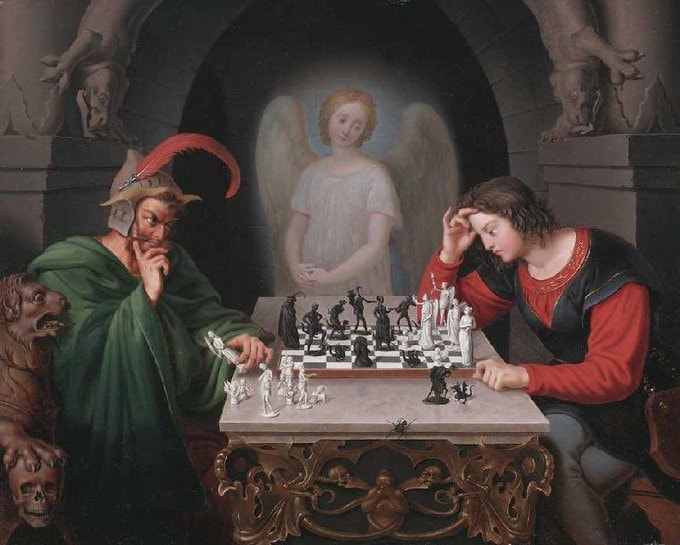
April 29, 2026
Checkmate
Le péché m’aurait sauvé.
("Sin might have saved me.")
The tears of the saint dried up, the Ever-Virgin's prayer rope broke, the psalm whispers ceased: מָרַנָא תָא. Who will cry this out to You and call You? Show us! Come!
Λόγε, fill the worlds with pan-meaning!
Never has man been in deeper and greater depression and crisis. This is uttered by the same man at almost every identical historical moment. Never again did I long for or seek meaning, roars the unconscious like the Euro-Atlantic tongue and spirit. Every generation will sigh the same until it collides with itself. Such a πάθος of the human soul is all the worse because the world, if for anything, then by the laws of horizontal, human perspective, is condemned to cold despair and an inevitable end. Dust, cobwebs, and darkness!
If it were not for Your joy... to say, even when I suffer and endure: I will bear, O Lord, a brilliant Cross to the insignificant Golgotha of my unnoticed life; I will trust in You like David; You will strengthen me when the time comes; the hand of the enemy will not be able to harm me; I will be far away like a bird of heaven from every creature. How mighty and gentle is Your hand, O God above gods... who knows what would have been.
Louvre is a well-known paradigm these days and a synonym for theft, but let's look at it from another Pascalian angle. The human spirit has always rejoiced in rebellion, freedom, but also in astuteness and depth.
More than thirty years ago, a group of tourists visited the Louvre. One of the exhibits at that time was a painting originally known as "Checkmate", by the German painter Friedrich Moritz Retzsch (1779–1857). It was exhibited in the Louvre until 1999 when it was sold to a private collector. The painting depicts a chess game between the devil and the human soul (man and an angel) in which man is losing the game.
The guide pointed to the painting and explained its meaning to his companions, and then continued the museum tour with them. A chess grandmaster remained almost motionless in front of the painting, captivated, observing this magnificent composition for a long time.
When the guide noticed he was missing, he urged the observer to return with them and continue the tour. It was then that the grandmaster uttered something that forever changed the fate of this painting and the perception of anthropology and theanthropy anew.
"I am a chess grandmaster. I have dedicated my life to it, and in this painting, I see what ordinary people cannot. What I see here is that man has not lost and it is not checkmate. Man still has one move with the King, with which he can finally win!"
Then there was silence and disbelief. The painting changed perspective, and the life of the composition completely turned in favor of man and God's angel.
However great the dead end, God's mercy and the sweetness of victory are even greater! However great the disbelief, fear, distrust, and darkness of modern and burdened man, traveling on the highways of hell, yet with the King – our Lord and Savior Jesus Christ, man has hope for the last word and victory.
Louvre is now synonymous with the rebellious and exultant. The reason for this is the fact that all the best and most wonderful creations of the human spirit have been gathered from all corners of the world, and the meaning and beauty that is in the eye of the beholder are found on the walls of this Parisian museum. This is certainly better – for these rare beauties to be met by the grandiose spirit of a grandmaster, whatever their name, rather than some "eco-activist" with a can of paint.
Emil Cioran, from the same tragic cry of existentialism today, exclaimed the first sentence of the text and also the following: "I should have remained her (the Church's) sinner, if not her believer." The deep fall of intellect and the inability to understand through faith led the great minds of the world into meaninglessness and foolishness, where they went astray in search of a "correct" understanding of God, the world, and the meaning of existence.
It is not much easier for us today; on the contrary, each new generation faces the greatest difficulty, not only for psychological reasons but because it is indeed the first generation to face a new kind of temptation.
Checkmate is when I make my final, winning move with the King.
Deacon Božidar Vasiljević